Never miss what matters.
Management by exception: response to exceptions in place of surveillance of dashboards. Pulse evaluates every change as it lands, against rules your own experts wrote, and only the exceptions reach a human. Watch. Decide. Act.
THEN alert(finance_lead)
Discount above policy, 2nd time this week
Pulse in action
Inside Pulse: rules written in plain English, watched continuously, deduplicated, and routed to the one person who needs to act.
The Rules Manager
The composer fills itself in, the dry run lands on 33 of 118 entities, and the rule goes live.
See it on your data →Write the rule yourself, in plain English
The people who understand the risk are rarely the people who can change the system, so the rule waits behind a ticket. In Pulse the expert writes it in plain language, field references are checked against the live data registry as you type, and a typo is caught at authoring, not at 3am.
- Dry-run on real data before anything goes live.
- 50,000 live rows scanned, 37 matches found, nothing persisted.
- Publish is instant and platform-wide.
- Every version is kept, audited and reversible.
COUNT 3×IN 30 days
THEN alert(operations_lead)
Carry a change to the person who needs it
A dashboard answers only when someone remembers to look, and the month-end report answers after the damage. Every insert, update and delete in a configured source is an event instead, whatever wrote it, and one pipeline carries it through to a decision.
- Captured as it happens: no polling, no nightly batch.
- Newly enabled rules immediately evaluate historical data to baseline.
- A real time full sweep catches drift and expiring time windows.
- Large evaluations partition automatically across the compute fleet.
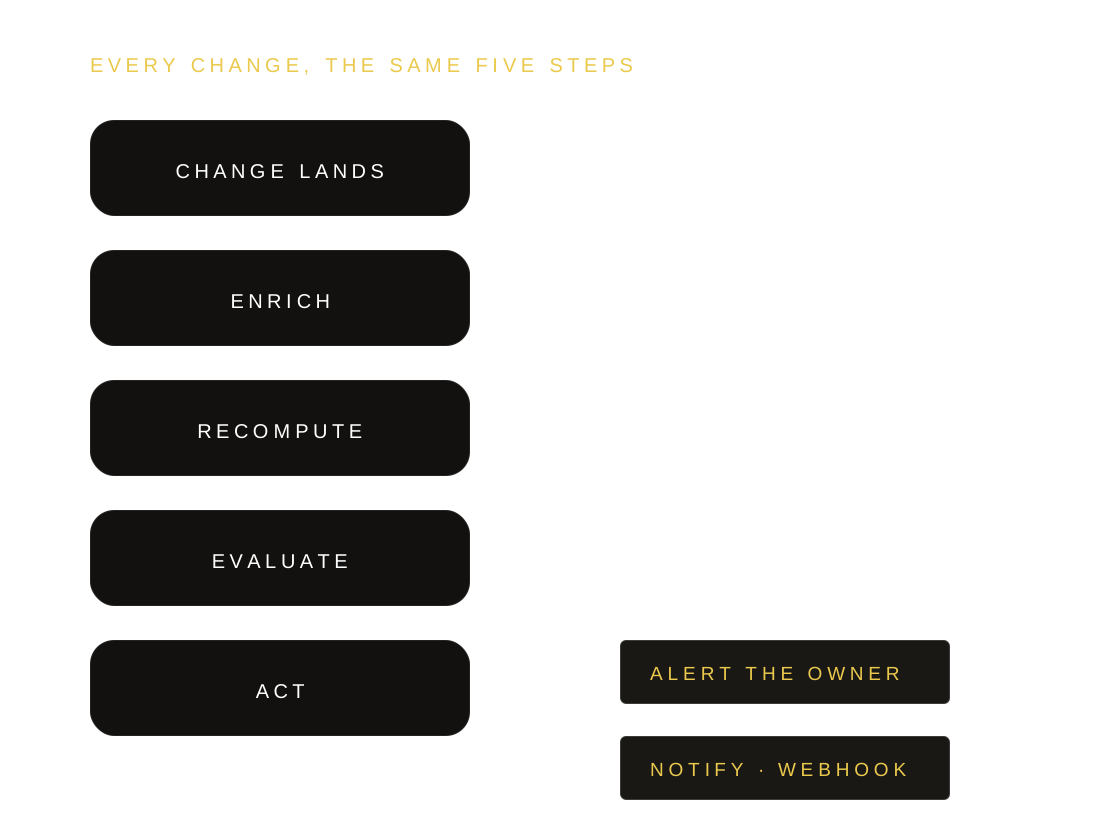
Millions of events in, a handful of decisions out.
Interrupt a human only when it is earned
An alert is an interruption, and a tool that sends too many teaches people to ignore it. Pulse makes each one unique, understandable and seen by exactly the right people. The same condition on the same entity is one open alert, so storms are structurally impossible.
- Severity and type: threshold, compliance, anomaly, predictive.
- The trend behind it, charted with the threshold position, in the alert.
- The records involved, entities and history, already joined.
- Read, snooze with auto-wake, dismiss: assigned, tracked, never orphaned.

One condition, one alert, one accountable owner.
Keep every KPI current on every change
A metric buried in a report definition drifts from the one buried in a spreadsheet, and the rule that depends on it breaks silently. Metrics are first-class calculations here: defined once, kept current on every change, and reused by every rule and dashboard.
- Aggregations over any entity, with rolling and to-date windows.
- Formulas compose calculations into new ones, recomputed in the right order.
- Circular definitions are refused at definition time.
- Deleting a used metric is refused, and the dependents are named.
Run it wide open, safely
An engine that watches everything needs controls stronger than the process it replaces. Pulse is governed by construction: versions kept, kill-switches everywhere, visibility enforced from the caller identity, and invalid configuration refused before it can run.
- Every rule versioned: full history, any version viewable, every change audited.
- Kill-switches per rule, per calculation, per channel: instant and platform-wide.
- Caller identity from the token, scoped alerts invisible to everyone else.
- One live map of your data: 13 services, 78 entities, 943 fields.
Per rule, per calculation, per channel: instant and platform-wide.
Full history, any version viewable, every change audited.
Invalid configuration refused at definition time, never found at runtime.

Runs with the other engines
Pulse and Horizon run on the same event backbone, scoped to each viewer permissions at every step. The same event that raises the alert moves the plan delivery probability, so managing by exception and planning share one truth.


Questions about Pulse
Watch. Decide. Act.
Watch everything. Surface only what matters. See it run on your data.