Ask in plain language.
Act on a cited answer.
Knowledge does not live in one place. Documents pile up in shared drives, decisions hide in email, procedures sit in wikis, and critical records live in domain systems. Keyword search returns files, not answers. Your answers already exist. Nexus makes them findable.
Two suppliers sit on order PO-2841. Norvell Components supplies the housing under a contract whose lead-time clause was renegotiated in March1, and Aster Polymer supplies the seal, which is the line item currently past its promised date2.
Nexus in action
Inside Nexus: ask in plain language, get the cited answer, and open the evidence at the source.
The estate, resolved and answerable
Documents, people, systems and records in one living graph: duplicates merged on arrival, questions answered along a lit path with citations, permissions enforced inside the graph itself.
The search workspace
The query types itself, results land in three languages, and every claim in the answer carries its citation.
See it on your data →Fuse, rank, synthesise, cite
A separate search per tool returns keyword lists of documents, and the work of turning them into an answer falls on the person asking. The channels return raw matches from across every source. Prophesee fuses, ranks, synthesizes and cites them, turning scattered data into information you can act on.
- Fused. Matches from every channel merged into one ranked result set, with no silos and no duplicates.
- Ranked. Ordered by relevance with a model that learns from how your organisation actually searches.
- Synthesised. The strongest evidence composed into a direct answer, not a list of links to open.
- Cited. Every statement traces to its exact source, section and page, so nothing is taken on trust.
Fused, ranked and cited beats a thousand raw matches.
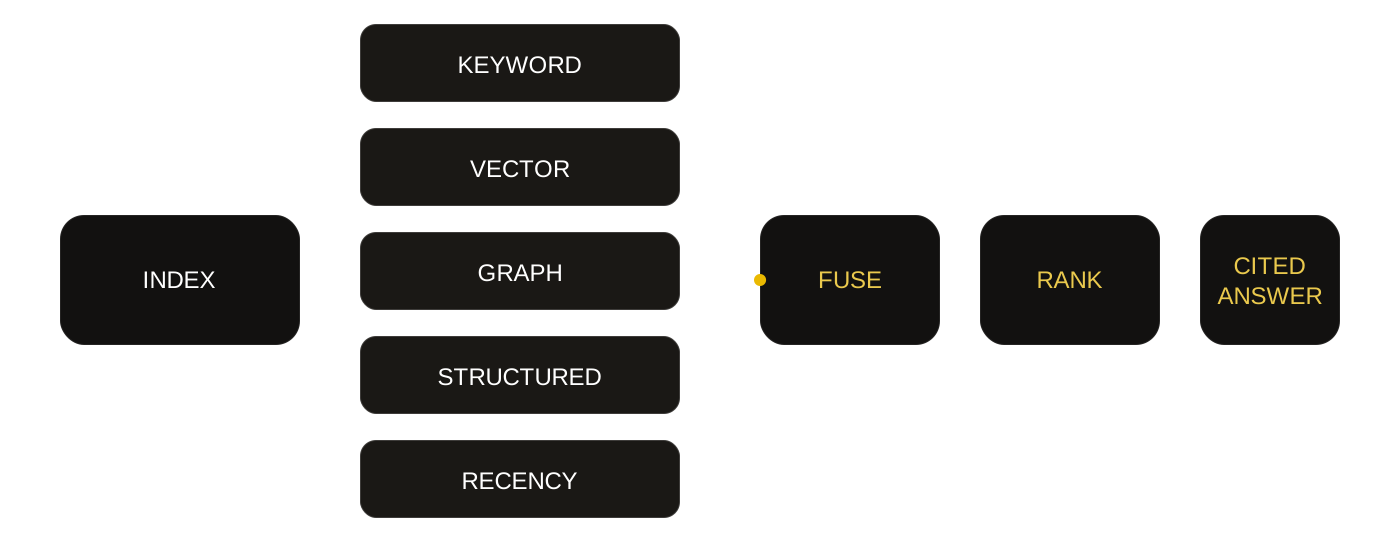
Indexing parses, chunks, embeds and extracts entities. Retrieval and ranking fuse the channels. Synthesis returns a direct, cited answer.
Connect it into a living graph
Keyword engines have no understanding of how information connects across systems, so knowledge that exists somewhere in the organisation simply cannot be surfaced. Information answers the question in front of you. Knowledge is the connected, living picture behind it. One graph relates every entity, captures the decisions that matter, and remembers how they change.
- Connected. Relationships are first-class, not buried in text.
- Decisions, captured. Decisions and the rationale behind them are linked to the evidence that drove them.
- Temporal. The graph remembers, with full history and versioning.
- Compounding. Every new source makes the graph richer, not just bigger.
Structure is what turns fragments into answers.
Organise knowledge by domain
A single generic index has no grasp of intent, so finance terms and engineering terms compete for the same relevance. Content is organised into configurable domain modules, each fully isolated. The platform ships with defaults and supports complete custom configuration for any business domain.
- Domain-tuned models handle per-domain entity extraction, vocabulary and ranking.
- Each module understands its own terminology.
- A general model handles semantic search, channel fusion and ML ranking.
- Orchestration routes each query to the right domain model and synthesises the answer.
One platform, many domains, each fully isolated.
Enforce permissions at every step
Permissions managed per tool leave gaps that a search index quietly widens. No user can discover or access content they are not authorised to see in the source system. Enforcement is built into retrieval, including within the graph, in redundant layers rather than a bolt-on filter.
- Source-faithful permissions, extracted from each system and canonicalised into cryptographic fingerprints.
- Graph-level checks. Fingerprints verified at every traversal hop, and unauthorised nodes are invisible.
- Delegated credentials. Searches run under the users own credentials, so the source system enforces access directly.
- Prompt-injection safe. Queries and content are delimited, they cannot alter instructions.
If you cannot see it at the source, you cannot see it in Nexus.
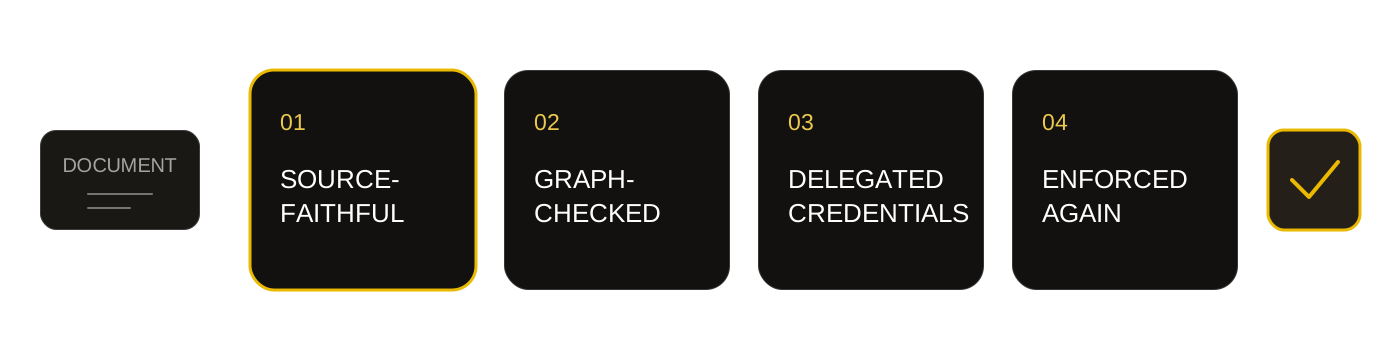
All AI on-premises, in-cluster. Encrypted in transit with TLS 1.3 to the gateway and mutual TLS between all internal services. Encrypted at rest, with secrets in an HSM-backed key vault and credentials mounted at runtime.
Stay fast under load, inside your cluster
Performance is more than a single latency number. We engineer and measure it across query speed, concurrency and indexing, end to end. Throughput holds across many concurrent users, search stays responsive under sustained load, with no latency cliffs.
- Query latency measured as TTFB and TTLB. First content streams in fast.
- Indexing runs continuously, and indexers scale independently of query serving.
- Every percentile from p50 to p99 tracked with OpenTelemetry, not just averages.
- Embedding, extraction and synthesis run in-cluster. No external APIs.
Fast for one user, and for a thousand.
Nexus drives Enterprise Search
The same engine that builds the graph powers the search your whole organisation uses every day: one search box reaching every connected source, a cited AI answer with a numbered source trail shown alongside results, faceted discovery by scope, source, file type and date, and inline previews that jump straight to the source. Ranking sharpens automatically from clicks, dwell and skips, with optional admin control for ranking rules, promoted results, synonyms and Q&A pairs.
Explore Enterprise SearchRuns with the other engines
Nexus is one of four engines on a single decision layer. The graph it builds is the context the others answer against, and nothing is modelled twice.


Questions enterprises ask
One search. Every answer. Any action.
Prophesee turns the data you already hold into living, connected knowledge, on your own infrastructure.